
What do BOD and DQO mean?
To ensure environmental preservation and compliance with legal standards, understanding the composition of the effluent is the first step. In the sanitation and industrial sector, two acronyms are fundamental: DBO e COD.
Each sanitation company in Brazil has its own internal service provision regulations, based on municipal, state and federal legislation (such as CONAMA Resolution 430). It is in these standards that the minimum requirements for the discharge of effluents into the public network or water bodies are determined.

These analyzes represent the amount of oxygen necessary for the decomposition of organic matter through different processes. The default unit of measurement is mg/L (milligrams of oxygen per liter of effluent).
- BOD (Biochemical Oxygen Demand): Measures the amount of oxygen consumed by microorganisms to degrade biodegradable organic matter. The most common pattern is the DBO (5,20), which indicates a test carried out for 5 days at a controlled temperature of 20°C.
- COD (Chemical Oxygen Demand): Measures the oxygen required to chemically oxidize organic matter (both biodegradable and non-biodegradable).
Important point: COD values are always higher than BOD values, as the chemical test oxidizes almost everything present in the effluent, while the biochemical test focuses only on what is biodegradable or “edible” for bacteria.
How to calculate Treatment Efficiency?
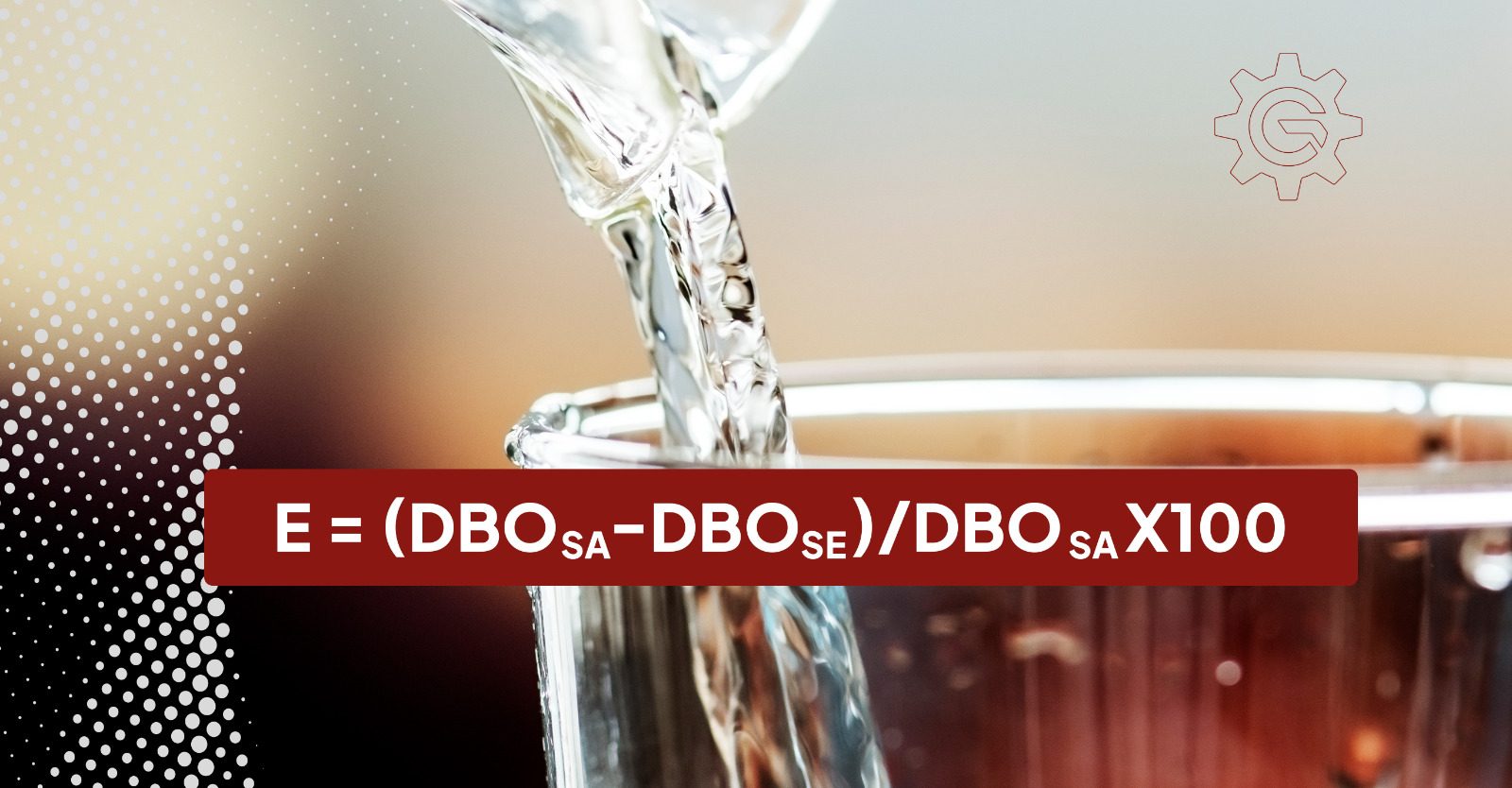
The efficiency of a treatment system is measured by the percentage of organic load removed between the inlet (raw effluent) and the outlet (treated effluent). The formula used is:

Where:
- E = Efficiency (in %);
- Cgross = BOD or COD of the Raw Effluent (mg/L);
- Ctreated = BOD or COD of the Treated Effluent (mg/L).
Practical Example: Joaçaba/SC
Using the regulation of the SIMA (Joaçaba/SC), which establishes maximum limits of 500 mg/L para DBO e 1000 mg/L per DQO for release on the public network.
If an industry generates a raw effluent with a BOD of 2500 mg/L and COD of 3300 mg/L, see the calculation of the necessary efficiency:
Efficiency required for BOD:

Efficiency required for DQO:

In this case, the treatment system must guarantee the removal of at least 80% of BOD and 70% of COD so that the company acts in full compliance.
From now on, you can look for treatment solutions!
Customized solutions for each industry
Different industrial branches generate effluents with different volumes, physical, chemical and biological compositions. Therefore, there is no “cake recipe”. The characteristics of these effluents vary according to the activities carried out by each institution, and the materials and substances used or generated in their processes. Therefore, the percentage of Efficiency required for launch varies from company to company, each company requiring a type of treatment, often requiring the use of secondary treatments (reactors and aerators), or even tertiary treatments, with some types of filters, among other processes.
Incorrect disposal of effluents poses serious risks to the environment and public health, in addition to heavy fines for the institution.
How can GRATT help?
A GRATT specializes in offering complete and customized solutions for each type of effluent. Our equipment covers everything from pre-treatment to tertiary level, including training, startup and performance improvement services.
Do you need to adapt your company to legislation? Get in touch now so that our technicians can carry out a specific study for your needs.